Traditional Industry Meets Modern Tech: JK Cement Builds Smart App Future via OutSystems
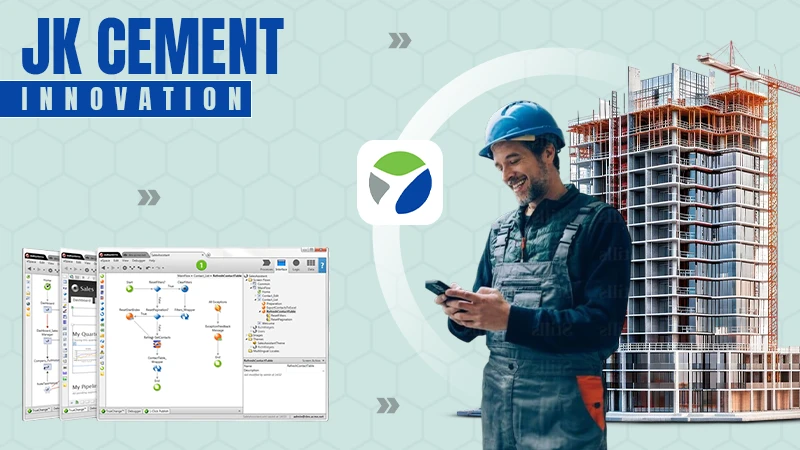
While in some sectors such as manufacturing, the development process of digitalization tends to be hampered by legacy software cycles. Diverging from such outdated software cycles, JK Cement Ltd., one of the leading manufacturers in India, has teamed up with OutSystems to incorporate its efficient low-code platform into its operations.
In other words, the integration has entirely redefined the way in which the grey and white cement maker designs, launches, and manages its enterprise software applications. Rather than having to write hundreds of lines of code manually to upgrade systems, JK Cement will rely on the development process provided by OutSystems to create applications quickly.
The overall objective of implementing the new technology is to streamline its scattered IT environment into a unified IT ecosystem that enables the company to develop responsive, high-visual mobile and desktop applications.
More specifically, there are three main categories for which the manufacturer plans to adopt this new technology: sales management optimization, complex land asset management, and redesigning corporate partner loyalty programs.
With the new low-code solution, the firm will be reducing the “go-to-market” time significantly, making the IT division respond promptly to shifting business needs. As the system automatically takes care of all the backend database operations and scaling in the cloud, the developers can concentrate fully on creating more user-friendly interfaces for users and partners.
It marks not only a shift toward digitalization but also a long-awaited trend among manufacturing industries. Software development is no longer considered a slow administrative task but an important competitive advantage.
Ditching old-fashioned IT infrastructure and embracing a swift centralized low-code engine, the company demonstrates that big manufacturing industries can be as agile as software startups. The rapid shift illustrates how upgrading old infrastructures can immediately bring about operational efficiency, thereby making room for sustainable digital-first industrial scale.