OpenAI Escalates Feud with Mathematicians and Cuts Caltech Event Funding
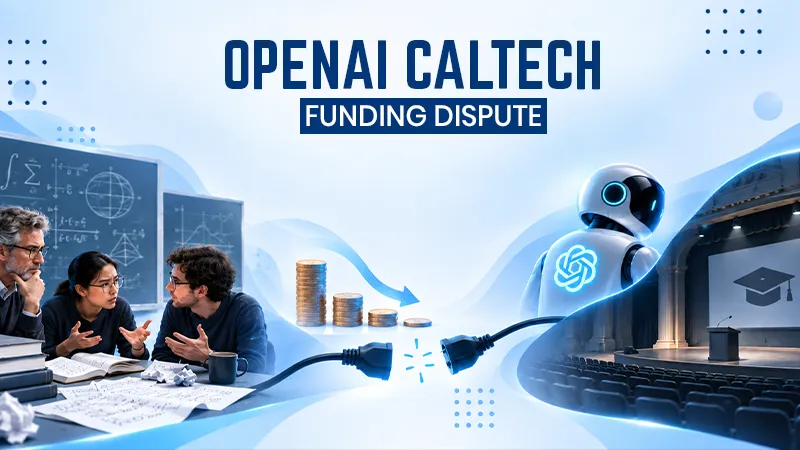
OpenAI has officially retracted its sponsorship from the Caltech Mathathon amid intense backlash from the academic community over its automated research practices. This follows the signing of an open letter by 25 renowned mathematicians accusing top AI labs of promoting scientific misinformation and producing automated “slop mathematics.”
Things heated up after OpenAI announced that it had solved the century-old Navier-Stokes Millennium Prize Problem using its AI models, raising claims of data scraping and research theft. The academic researchers accused OpenAI of taking advantage of ongoing, unpublished mathematical research available on its Codex developer platforms to expedite its breakthrough discoveries.
In particular, the NYU mathematician Tristan Buckmaster and the Anthropic researcher Levent Alpöge have publicly expressed concerns about OpenAI using the unpublished draft data to scoop their results. The OpenAI executives vigorously denied using any user data, asserting that its reasoning models independently produced the solution using compute scale.
In light of the growing criticism, the OpenAI research lead declared that their company would withdraw from sponsoring the competition held at Caltech, stating that the conflict was an expected result of such a fast change in technology. Even though there is no funding from OpenAI, the competition with a prize of $2,000,000 in compute credit will still take place with other corporate sponsors.
Such a public confrontation illustrates the core contradiction of the modern research infrastructure in terms of data governance, intellectual property, and academic attribution. With the emergence of AI developers using huge compute capital to claim basic scientific discoveries, the issue of rights to automated research is highly controversial.
The confrontation between OpenAI and academic institutions serves as an example of increasing conflicts regarding the use of generative platforms in human research, thus determining intellectual property rules for the future.