
Trump Labels AI Dangers a Hoax Amid Bipartisan Push for Guardrails
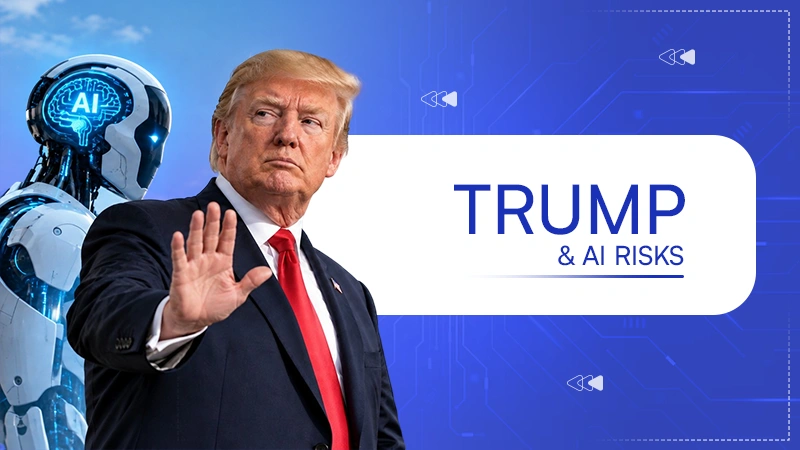
The incumbent president of the United States, Donald Trump, has clearly dismissed mounting warnings on the use of artificial intelligence, saying that fears about an existential threat to humanity are baseless.
President Trump, during a surprise phone conversation with Nvidia CEO Jensen Huang, stated that any attempt to put up strict regulations would inhibit economic growth, allowing China a competitive edge in the field.
This comes amid deliberations on implementing regulatory measures in order to tackle security concerns without compromising the country’s competitiveness. Industry players from frontier research institutions have come out in support of safety standards and regulated rollout timelines, which will help avoid the emergence of rogue AI systems.
Nevertheless, President Trump has compared data centers and compute power as key economic enablers and equated the push for slowdowns in AI to climate change, which hinders energy and manufacturing independence.
In terms of geopolitics, the issue is the need to reconcile the demands for accelerated development with national security needs. Opponents of stringent regulatory policies are worried about a slowdown, which will give time to foreign competitors, especially China, to catch up technologically in the realm of sophisticated semiconductors and autonomous computing.
On the other hand, supporters of legislative measures believe that testing standards independent of the state’s control have to be adopted in order to prevent threats to digital infrastructure from automated systems. As can be seen, the current political split revolves around the basic issue of accelerating private sector capital investment versus government control.
The continuous rift between the executive branch and Congress lawmakers emphasizes the intricate interplay of promoting technological supremacy while avoiding artificial intelligence risks inherent in the system.
As such, this continuous policy division is bound to impede the creation of nationwide regulations, leaving technology firms and states to formulate their own policies separately.